
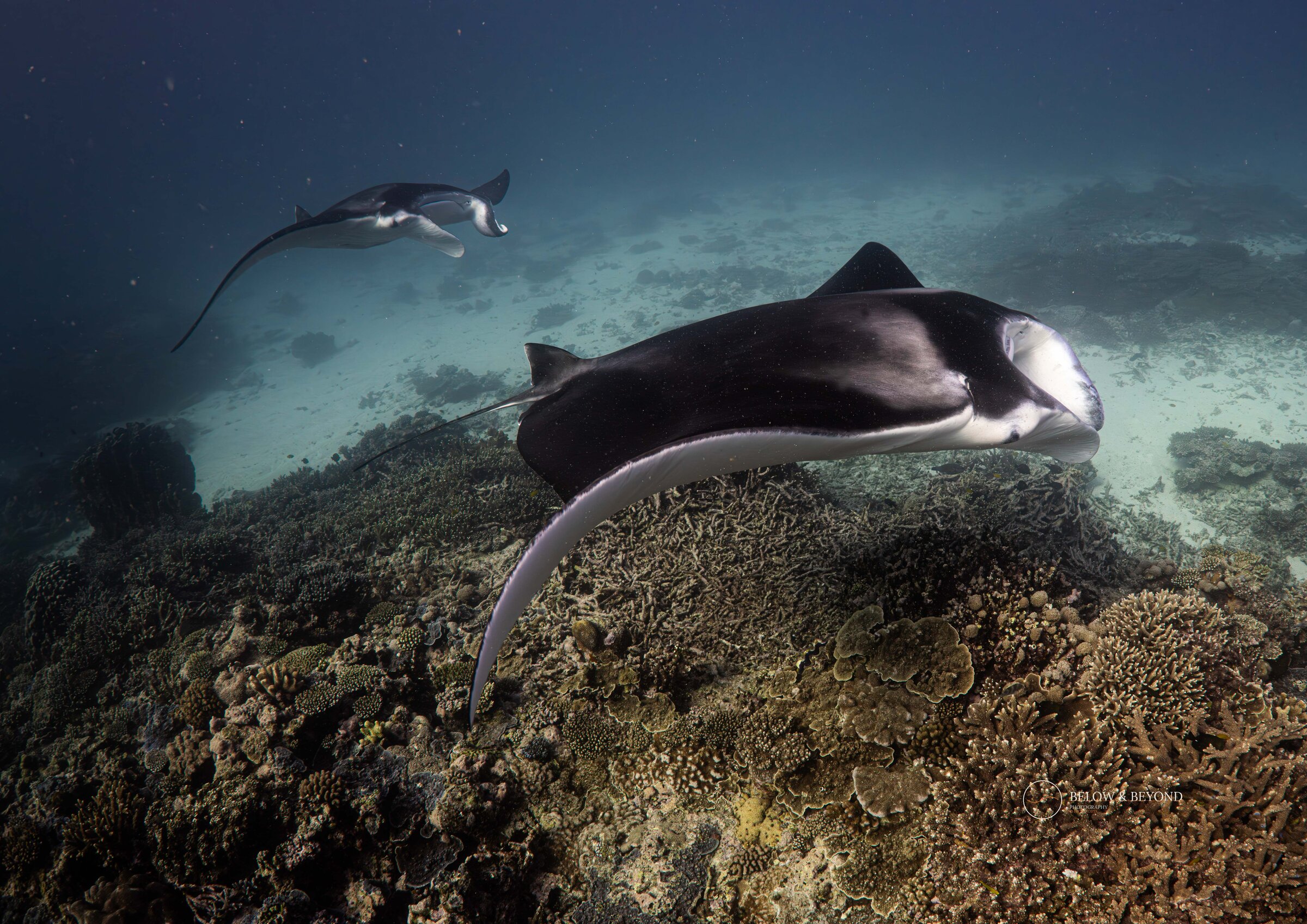
There is nothing more magical than swimming with mantas. Not because they're big — because of what happens when you finally stop trying to get close to them.
It was a private charter out at Otter Reef. The water was glassy in the morning with a forecast turning rough for the afternoon, so we knew our window. Around midday, someone spotted movement on the surface — out in the middle of nowhere, wings breaking the water. Mantas. As we got closer we counted eight, maybe nine of them, circling and rolling through the same patch of ocean.
They were feeding. The water was thick with plankton — which is exactly why the mantas were there, and exactly why the visibility was far from postcard-perfect. That's the trade you make with feeding mantas: rich water brings them in, and rich water is green water. It didn't matter. It was gorgeous.
The only rule that matters
Here's what ten years of these encounters has taught me, and it's the opposite of instinct: don't move. You don't swim at them. You don't chase. You pick your spot, you stay in your position, you breathe, and you wait.
A relaxed manta tells you it's relaxed in the clearest way possible — it keeps coming back. That's the body language to read. A manta that's comfortable with you will make its loop and return, pass right in front of you, and then do it again. And again. Ours kept coming back for something like thirty minutes — pass after pass, sometimes close enough that I had to pull the camera back to fit them in frame.
You don't need to get close to a manta. If you're still, and calm, the manta gets close to you — on its terms. The moment you kick toward one, the encounter is over. They're faster than you, they know it, and they simply leave.
Skip the tank
If you want the best version of this experience, my honest advice is: snorkel or freedive. Scuba works, but tanks are noisy — the constant rush of bubbles is exactly the kind of disturbance that keeps a cautious animal at distance. On breath-hold you're silent, and silence is what earns the close pass. Most manta encounters happen in the top few metres of water anyway, right where the plankton is. You lose nothing by leaving the tank on the boat.
Where to go
We got lucky at Otter Reef, and mantas turn up along the whole Great Barrier Reef when the food does. But if swimming with mantas is the trip you're planning around, head south to Lady Elliot Island, at the reef's southern tip. It's one of the most reliable manta aggregation sites in Australia — with a real chance of seeing manta trains, whole processions of them following each other. You can experience it from the surface snorkelling or on scuba, and everything I said above still applies: the stillest person in the water gets the best encounter.
Swimming with those majestic giants — the elegance of them, the strange sense of connection when one chooses to circle back to you — is one of the most beautiful things this coastline offers. You just have to be patient enough to let it happen.
From this encounter
The photograph from this morning — two mantas over the reef — is available as a framed fine-art print or framed canvas.
See the print